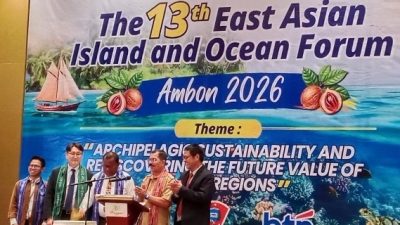


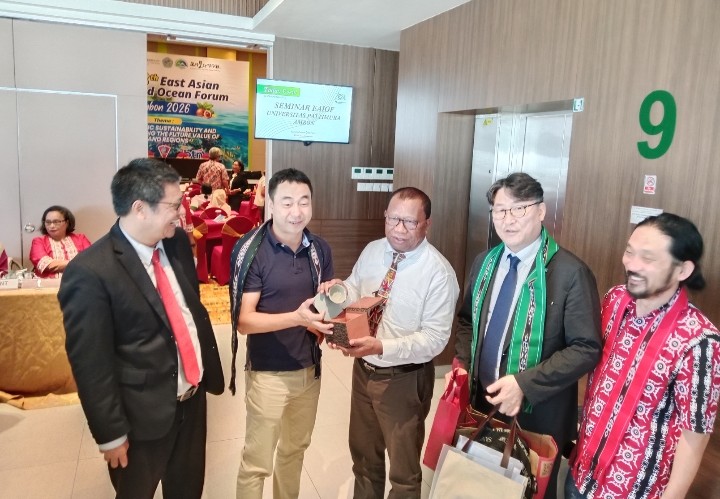
AMBON, SIRIMAUPOS.COM – The 13th East Asian Island and Ocean Forum (EAIOF) 2026, hosted by Pattimura University (Unpatti), was held in Ambon, Maluku, on Monday (November 23), bringing together academic perspectives and strengthening international cooperation on island and ocean sustainability.
Since its establishment in 2013, EAIOF has demonstrated how regional academic collaboration can grow into an international network connecting higher education institutions and research organizations across countries.
EAIOF Founder, Professor Sun-Kee Hong of Mokpo National University, South Korea, revealed that the forum initially involved 12 institutions from four countries: South Korea, China, Japan, and Taiwan.
From the beginning, EAIOF was designed as a platform for academic collaboration, with a focus on island communities, cultural heritage, environmental sustainability, and the future of people living in island regions.
Speaking at the 13th EAIOF 2026 in Ambon, Sun-Kee Hong explained that the founding vision of the forum was based on the belief that islands are not merely geographical territories surrounded by water. Rather, they are living spaces rich in cultural heritage, ecological diversity, indigenous knowledge, and future development potential.
This perspective has become the foundation for academic cooperation across East Asia. Over the years, the forum has continued to expand institutional participation and strengthen cross-border communication to advance research on island and ocean-related issues.
Hosting the 13th forum in Ambon, Maluku, marks an important milestone in EAIOF’s development. Indonesia’s participation, particularly through Maluku, is expected to bring new perspectives to academic collaboration between East Asia and Southeast Asia.
Sun-Kee Hong emphasized that Maluku has strong relevance to EAIOF’s vision and mission. Its archipelagic geography, rich marine resources, cultural diversity, and the experiences of communities in managing island life represent valuable sources of knowledge for international research and academic development.
He described the forum in Ambon as more than just an academic conference. It is an important step toward strengthening academic relationships, broadening research perspectives, and building solidarity among island communities across different regions.
On the occasion, Sun-Kee Hong also expressed his appreciation to Pattimura University Rector Fredy Leiwakabessy and the university’s leadership team, Organizing Committee Chair Professor Dr. Wardis Girsang, and the entire organizing team for their efforts in preparing the international event.
According to him, organizing international programs requires careful planning, coordination, cooperation, dedication, and commitment from all parties. The support of the host institution, therefore, plays a crucial role in ensuring the continuity of the forum.
He expressed hope that EAIOF 2026 would further strengthen cooperation among universities and researchers while generating more productive collaborative programs that deliver tangible benefits to island communities.
Furthermore, Sun-Kee Hong viewed academic cooperation as an important contribution to building world peace. Knowledge exchange, cross-cultural understanding, and international solidarity, he noted, can strengthen relationships among communities and nations across different regions.
“Islands and oceans should not become boundaries that separate us, but rather bridges that connect communities, cultures, knowledge, and nations,” he said.
His statement reflects EAIOF’s fundamental philosophy that island regions should be regarded as connecting spaces rather than peripheral territories isolated from the world’s centers of development.
With Ambon serving as the host city, EAIOF is entering an important new chapter in expanding the reach of regional collaboration. The involvement of Indonesian universities creates opportunities to develop research agendas that are more responsive to the specific characteristics and challenges of Southeast Asian island regions.
Looking ahead, the forum’s sustainability is expected to be strengthened through joint research initiatives, academic exchanges, institutional capacity development, and various programs supporting the responsible management of island resources.
Ultimately, EAIOF’s journey since 2013 represents more than the growth of an academic forum. It reflects a broader international commitment to building knowledge-based solidarity for the future of islands, oceans, and the communities that depend on them. (*)